Mahasiswa
1.245
Jurusan Unggulan
3
Program Studi
14
Tenaga Pendidik
130
Alumni
5.696
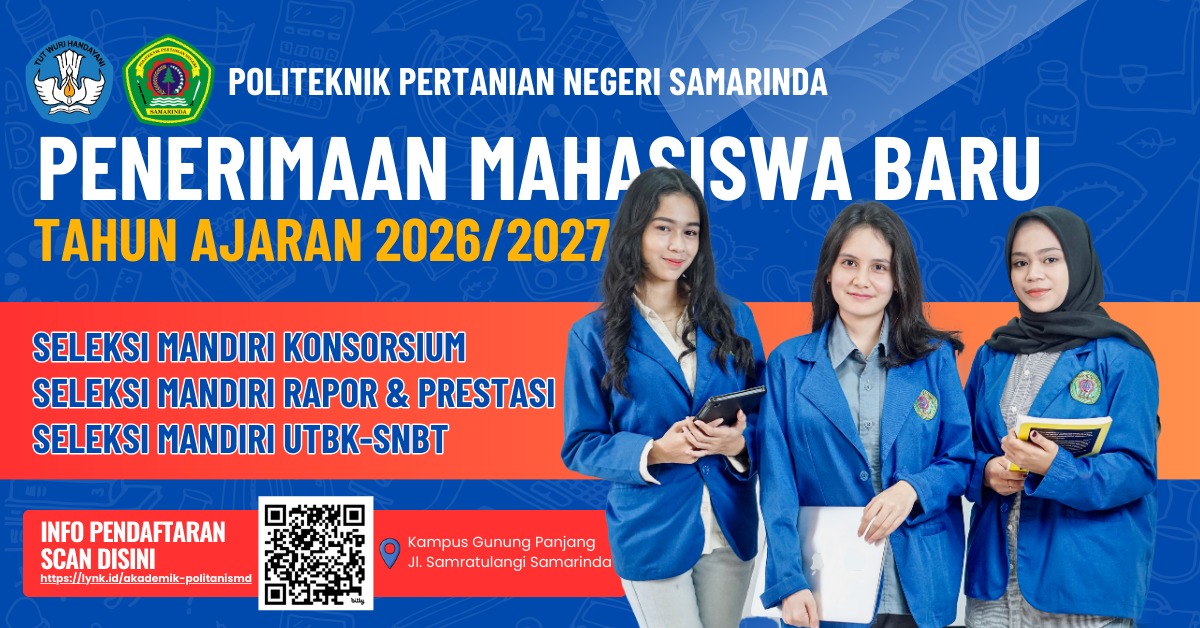
Siap Membangun Masa Depanmu?

Mencetak generasi unggul di bidang pertanian, kehutanan, dan teknologi terapan dengan fasilitas lengkap dan tenaga pendidik berpengalaman.
.jpeg)

Sambutan
Direktur Politeknik Pertanian Negeri Samarinda
Selamat datang di Politeknik Pertanian Negeri Samarinda. Kami hadir untuk melahirkan generasi inovatif, tangguh, dan berintegritas. Dengan kurikulum vokasi yang adaptif terhadap kebutuhan industri, POLITANI siap menjadi mitra strategis pembangunan pertanian Indonesia. Bersama, kita tumbuhkan ilmu, inovasi, dan keberlanjutan untuk masa depan bangsa.
Berita Kampus
Kabar Seputar Kampus

General information • 2 October 2026
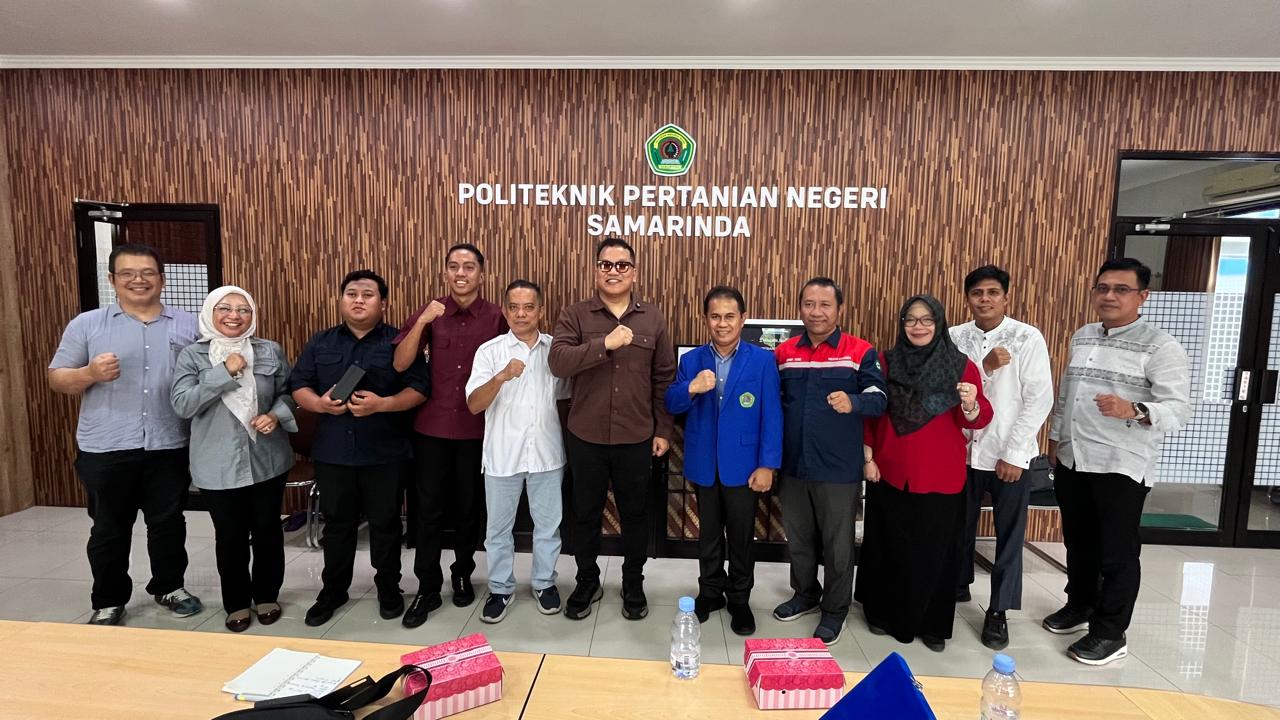
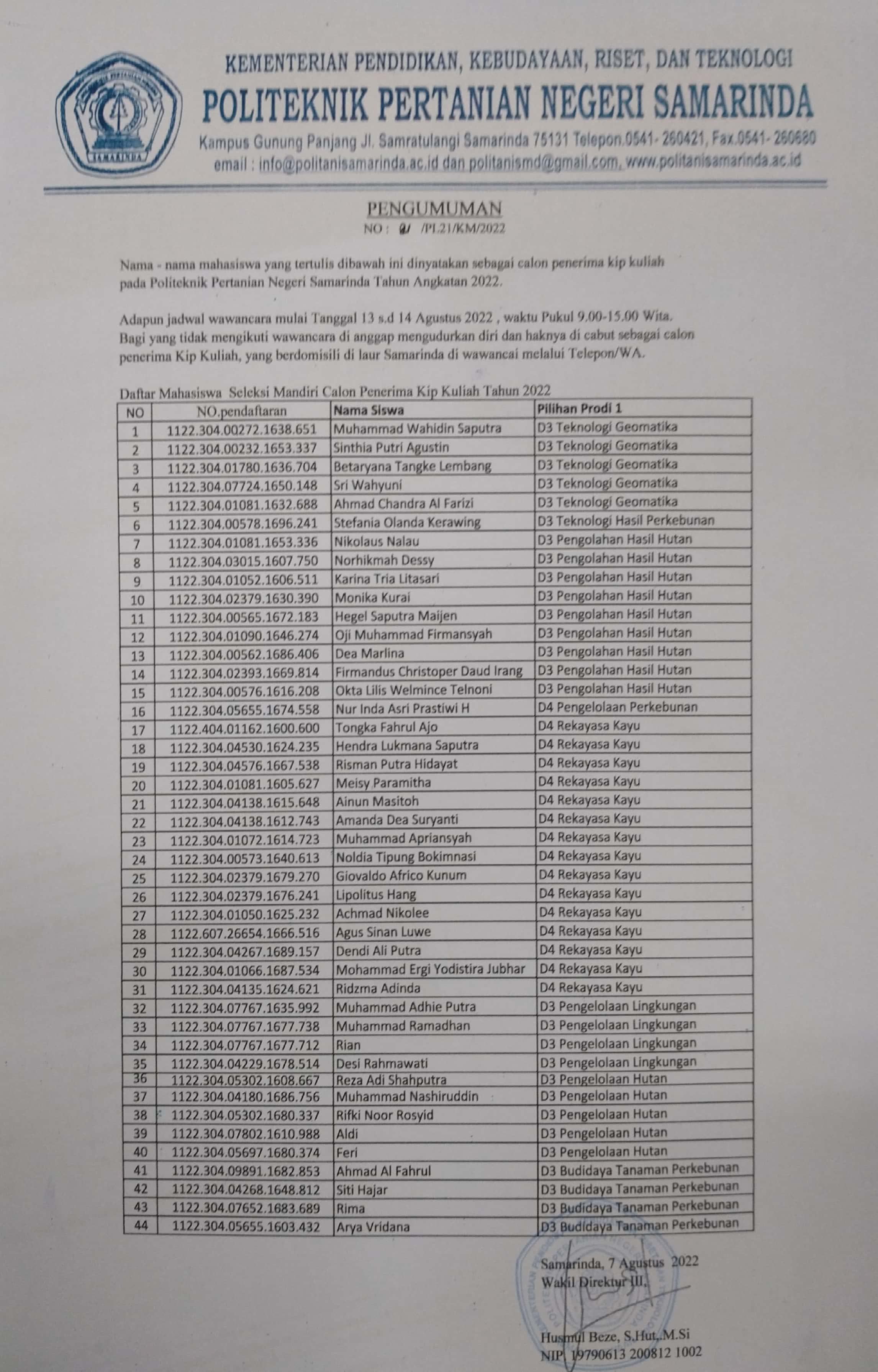
Visit by House of Representatives Commission X Member Edi Oloan Pasaribu: Gathering Input on Higher Education at Politani SamarindaSamarinda, October 17, 2026 – The Samarinda State Agricultural Polytechnic (Politani Samarinda) received a visit from Edi Oloan Pasaribu, S.T., M.M.—a member of Commission X of the House of Representatives of the Republic of Indonesia (DPR RI) representing the National Mandate Party (PAN) for the East Kalimantan electoral district—on Friday, October 16, 2026. The meeting took place on the second floor of the Politani Samarinda Directorate Building and was hosted by the institution’s Director, Dr. Heriad Daud Salusu, S.Hut., M.P., alongside the leadership team. This visit was part of Edi Oloan Pasaribu’s official duties as a member of Commission X, aimed at gathering input from stakeholders in the education sector. Key topics of discussion included access to and the affordability of higher education, the equitable distribution of educational services, the availability of scholarships, and the various challenges involved in delivering higher education in East Kalimantan. The meeting served as a dialogue platform between the legislature and the higher education institution, facilitating the collection of feedback regarding the development needs of vocational higher education. The insights shared are intended to serve as a reference for the DPR RI in carrying out its legislative, budgetary, and oversight functions, in accordance with the mandate of Commission X. In the discussion, the focus on inclusive and equitable access to higher education emerged as a key issue. The availability of financial support, the equitable distribution of scholarships, and the strengthening of learning facilities are all vital factors in expanding opportunities for the public to pursue high-quality higher education. As a public vocational higher education institution specializing in agriculture, plantations, engineering and computing, as well as the environment and forestry, Politani Samarinda plays a strategic role in preparing skilled and competent human resources tailored to the needs of the labor market. The development of vocational education requires sustained policy support, adequate learning infrastructure, and a stronger emphasis on practice-based learning, ensuring that graduates are well-equipped to address regional development challenges. The Director of Politani Samarinda, Dr. Heriad Daud Salusu, S.Hut., M.P., along with his leadership team, utilized this meeting as an opportunity to strengthen communication and share various perspectives on the delivery of vocational higher education. The dialogue also served as part of an effort to build synergy between the institution and policymakers, aimed at enhancing the quality of education and fostering human resource development in East Kalimantan. Gathering these insights is expected to sharpen the focus on the tangible needs of vocational higher education institutions—particularly in expanding access, improving the quality of academic services, and ensuring the sustainability of institutional development programs. Synergy between the House of Representatives (DPR RI), the government, and higher education institutions is a crucial element in creating a higher education ecosystem that is adaptive, inclusive, and responsive to the needs of society. Through this visit, Politani Samarinda underscored the importance of ongoing collaboration to strengthen impactful vocational education. Such efforts are expected not only to enhance the quality of learning and graduate competencies but also to broaden the institution’s contribution to regional development and the cultivation of exceptional human resources for Indonesia. (PUBLIC RELATIONS)
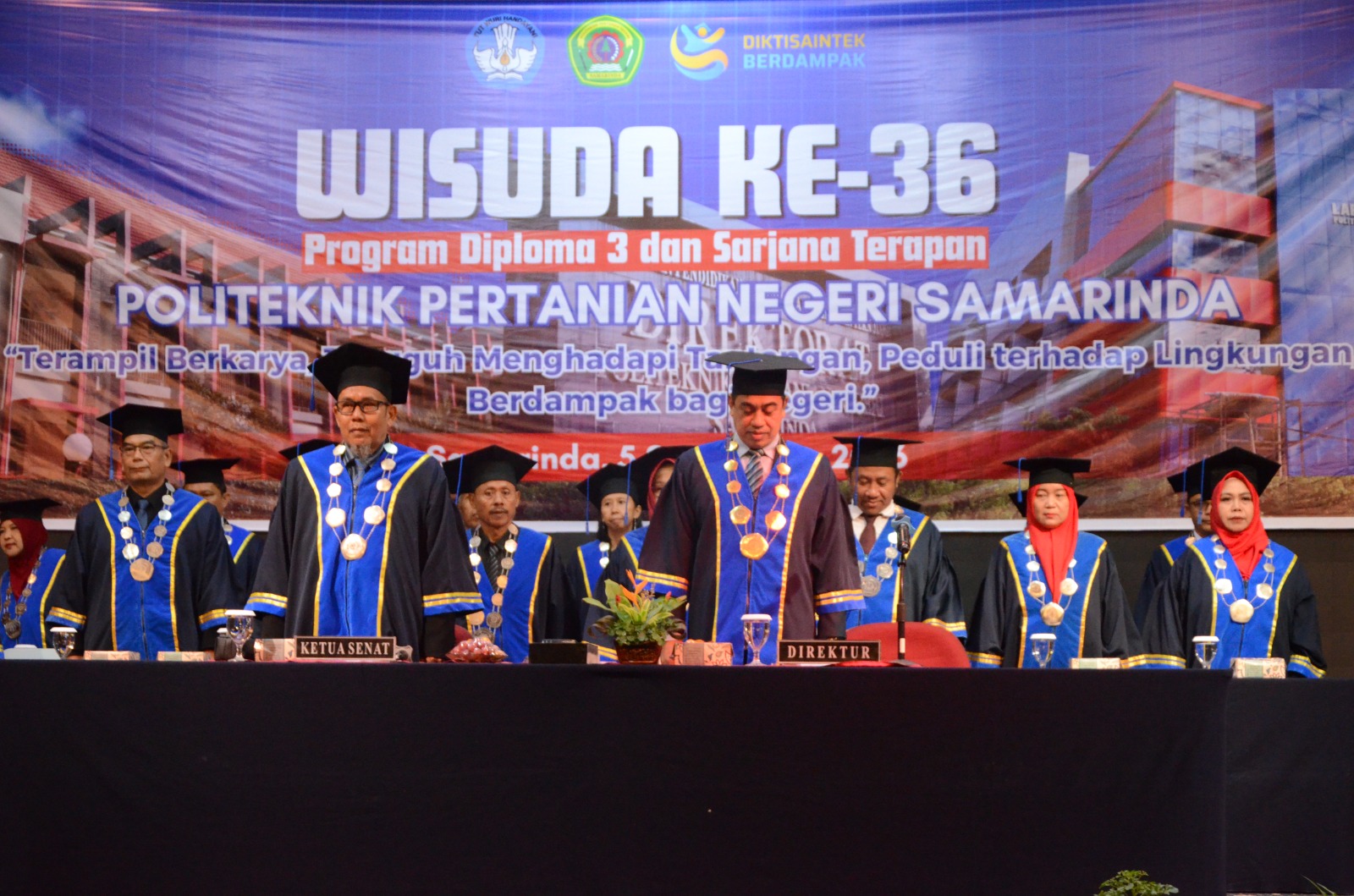 Politani Samarinda's 36th Graduation Ceremony Held, 3 Majors Graduate Hundreds of Graduates
General information • 05/09/2026
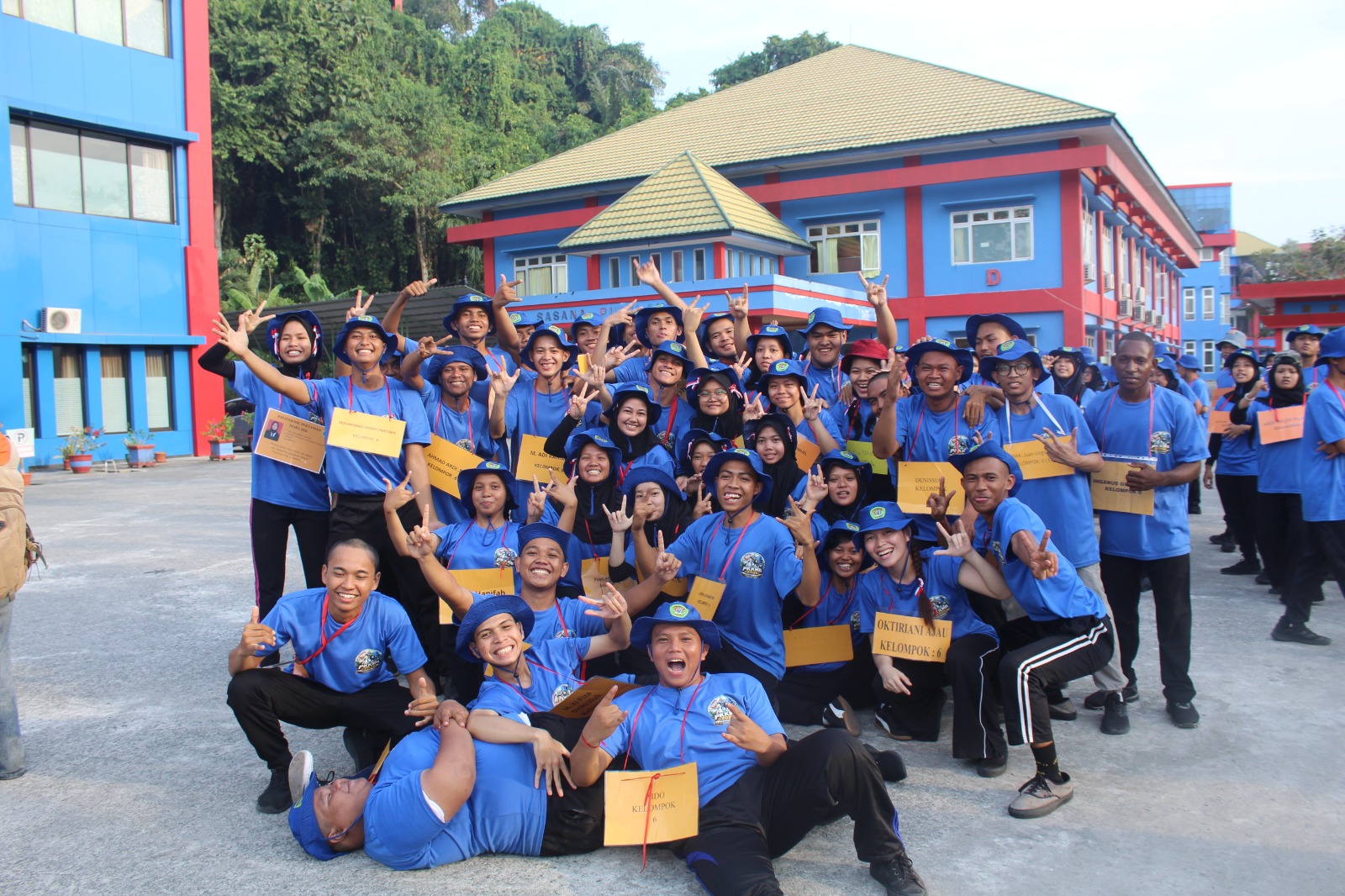 Samarinda State Agricultural Polytechnic Successfully Hosts 2026 Pre-PKKMB and PKKMB Events
General information • 24/08/2026
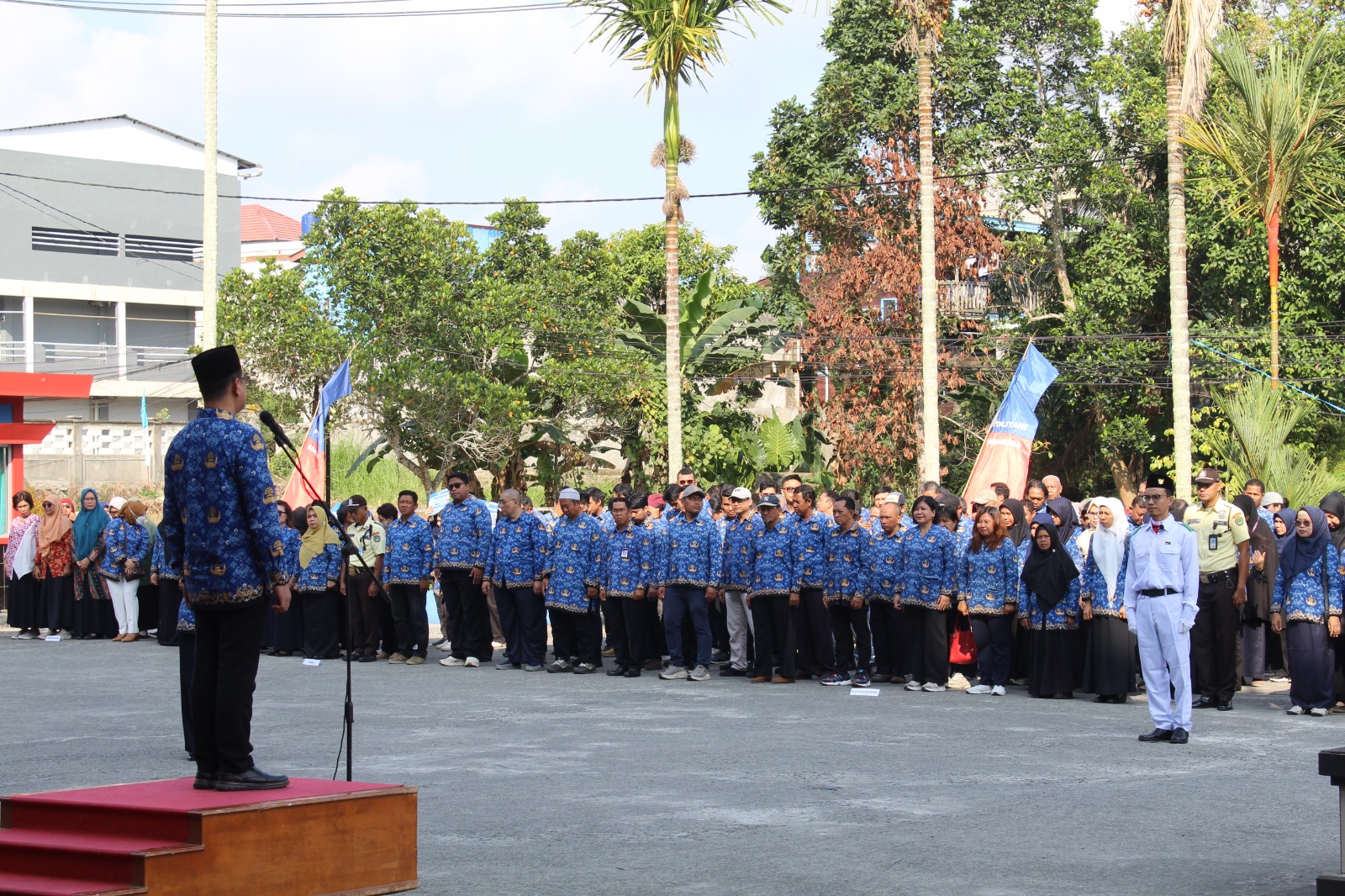
 Samarinda State Polytechnic of Agriculture Drives Agricultural Innovation; Rice Productivity of GAPOKTAN Mandiri Increases by 44.83%
General information • 10/09/2026
Akademik
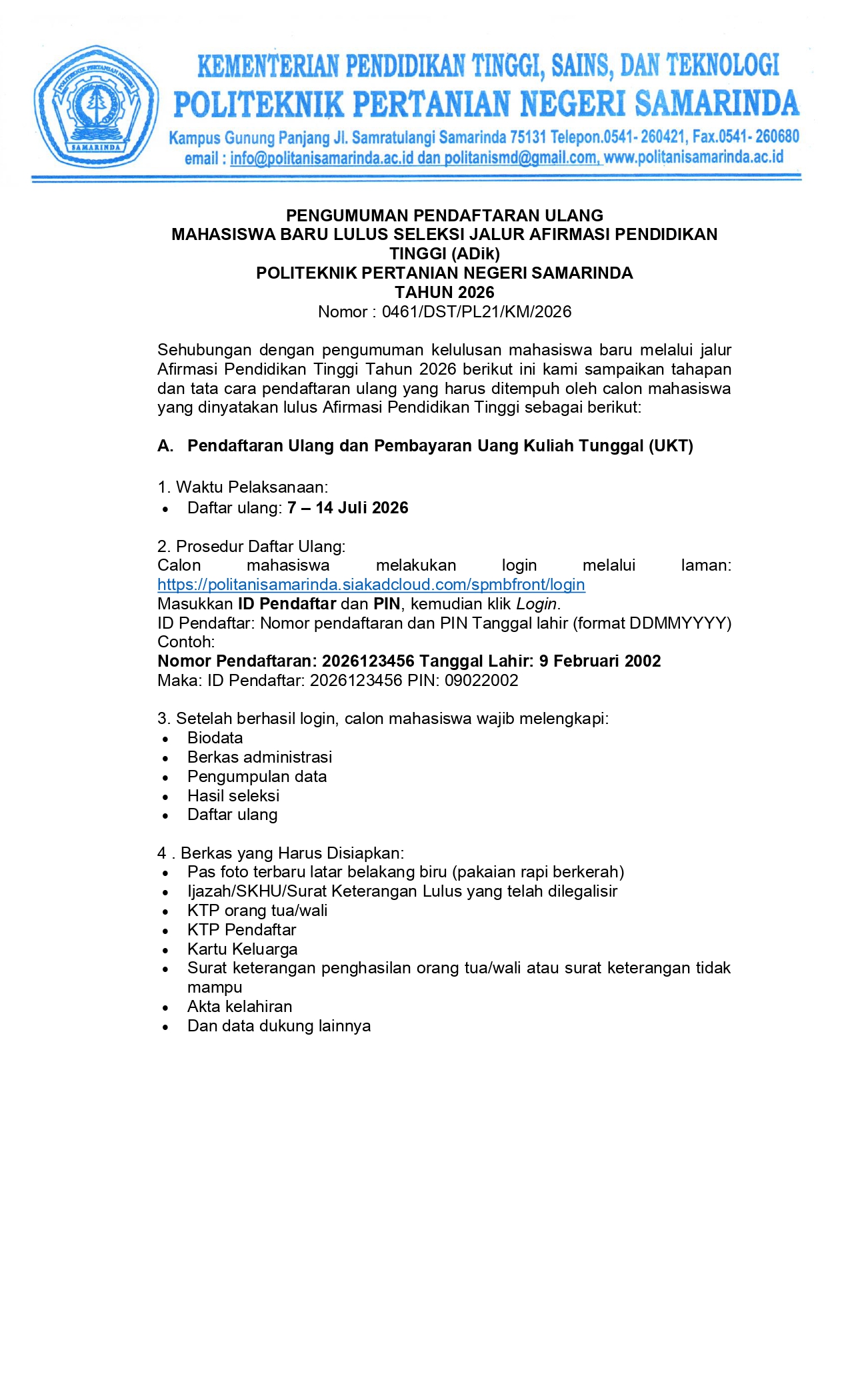
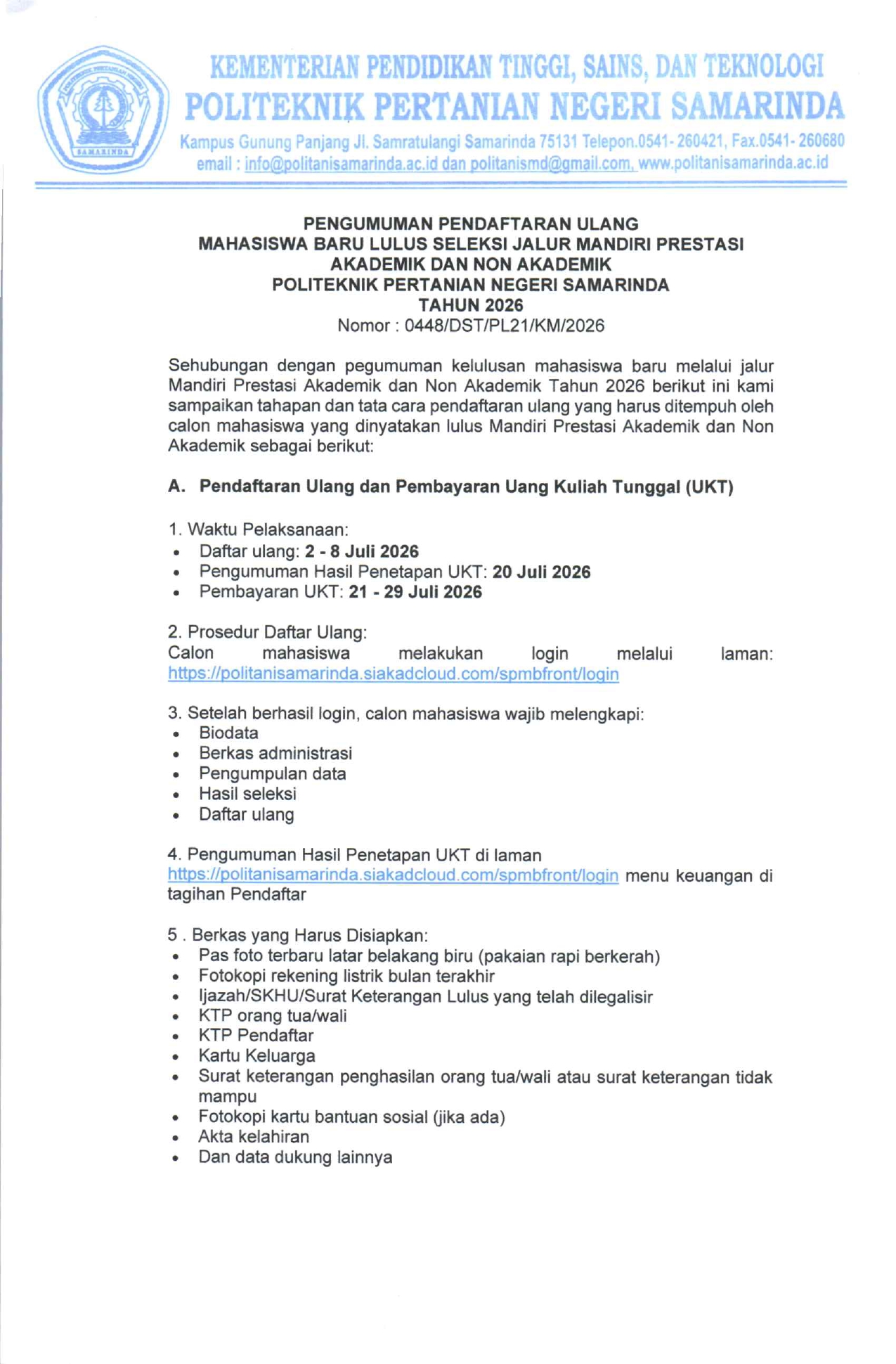
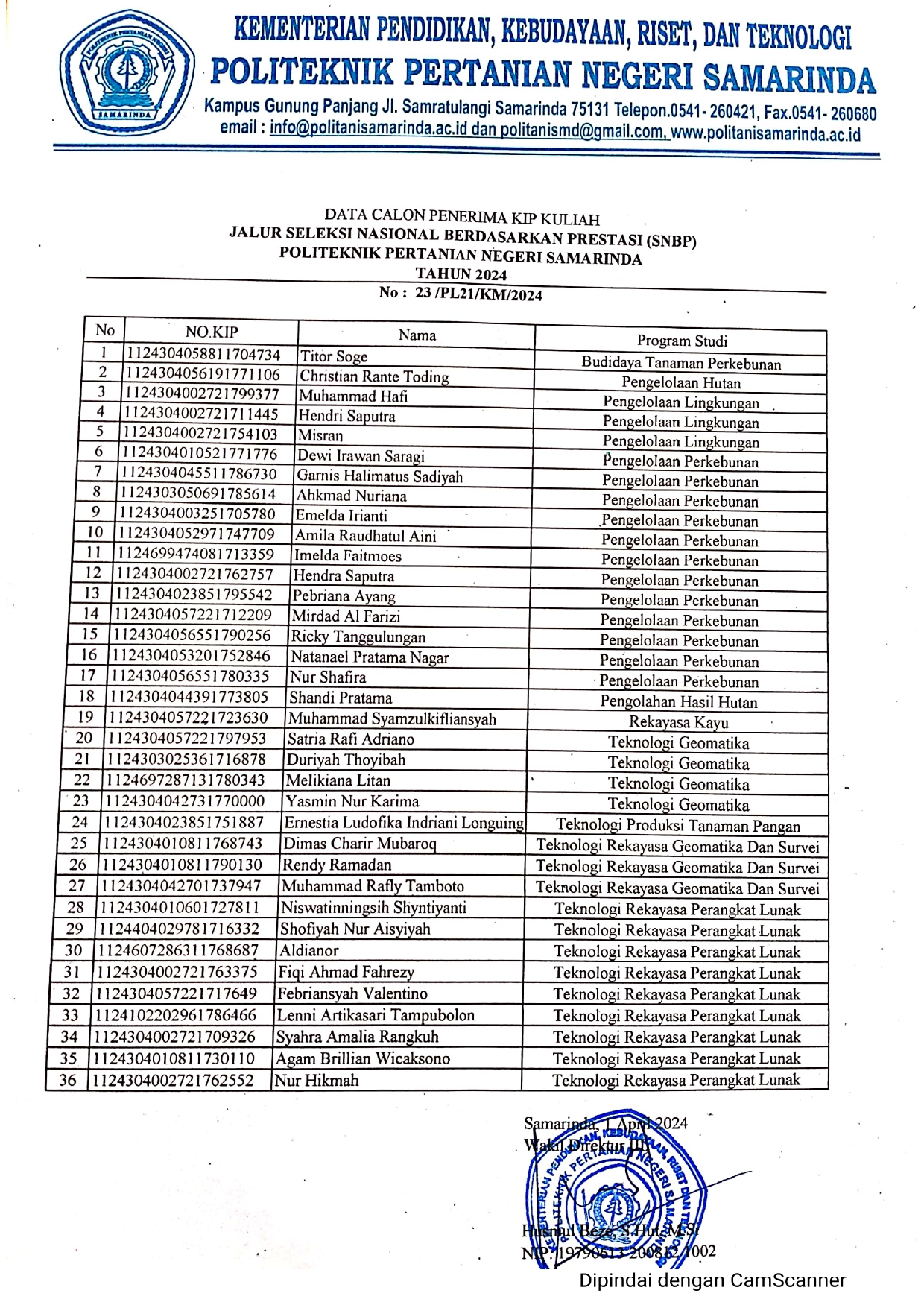
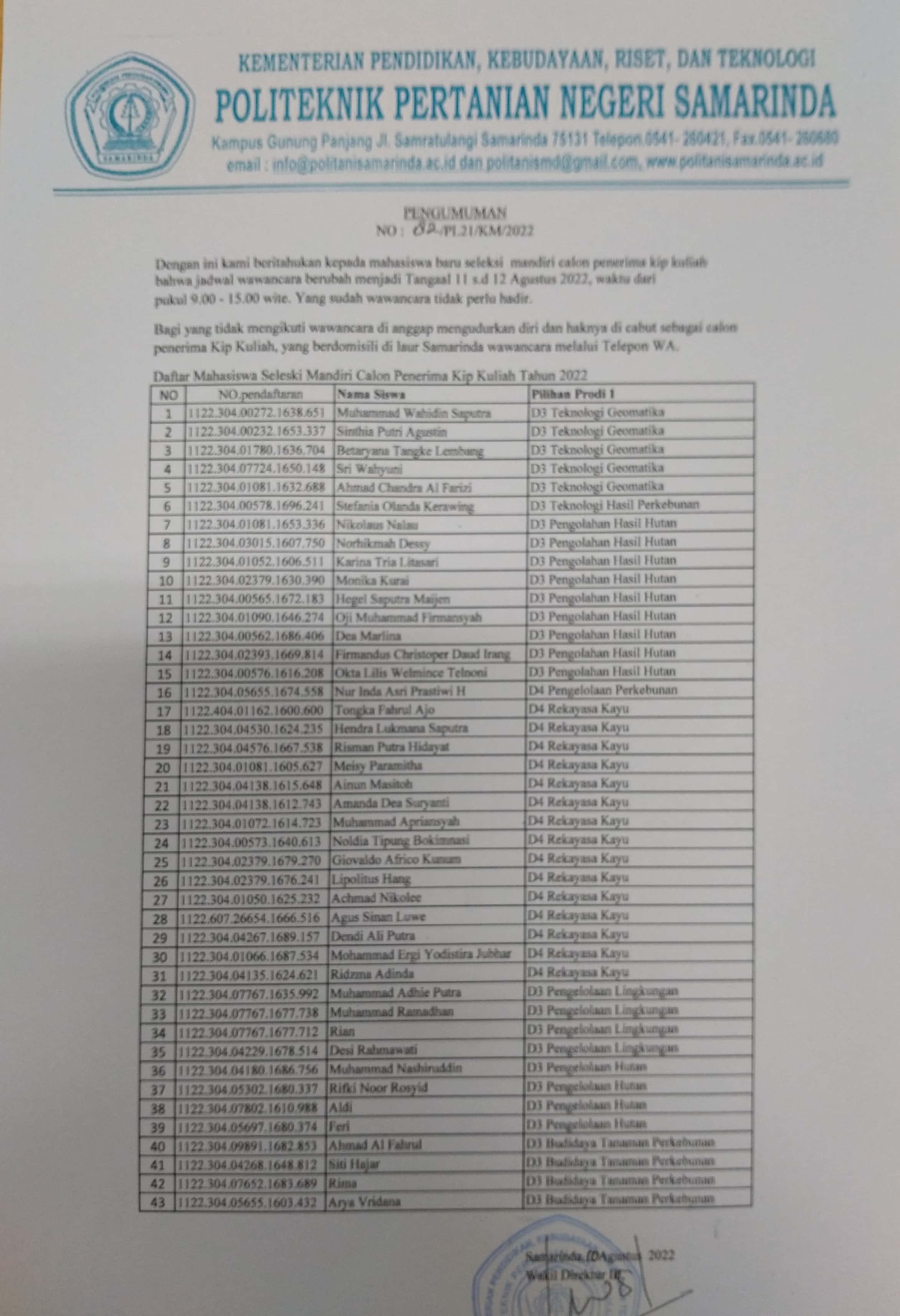
Kemahasiswaan
Kerja Sama
Kemitraan & Kolaborasi Strategis
Menjalin kemitraan strategis dengan masyarakat melalui pendidikan dan penelitian
Program Studi
Prodi Unggul Menuju Generasi Berdaya Saing
Dengan pendekatan pembelajaran yang berorientasi pada industri dan riset terapan, program studi kami membantu mahasiswa menjadi inovator muda yang siap memberi dampak positif di bidangnya masing-masing.
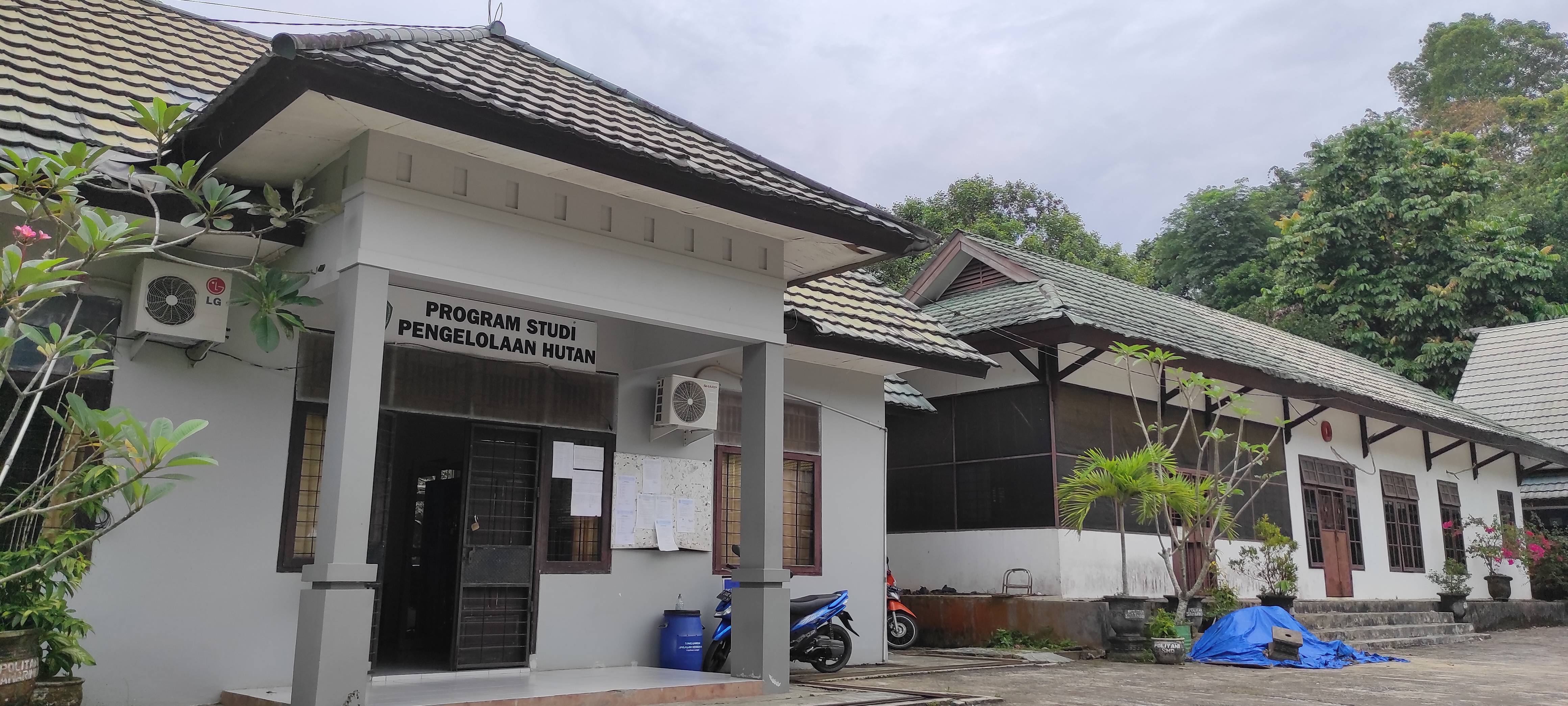
Pengelolaan Hutan
Program Studi Pengelolaan Hutan Pendirian program studi Pengelolaan Hutan ini sebagai pengembangan dari program-program studi yang telah lebih dulu didirikan di Politeknik Pertanian Negeri Samarinda. Program studi ini didirikan dalam rangka memenuhi tuntutan pembangunan yang terus berkembang dan perlu diiringi dengan upaya pengelolaan lingkungan oleh sumberdaya manusia yang memadai dibidangnya agar pembangunan tersebut dapat dilaksanakan dan bermanfaat secara berkelanjutan. VISI : “Menjadi salah satu progam studi vokasi secara nasional yang memiliki keunggulan komperatif dan kompetitif dalam menyelenggarakan pendidikan dan penelitian dibidang Kehutanan tahun 2020.” MISI : Melaksanakan pendidikan vokasi dibidang kehutanan dengan lulusan yang berkualitas Melaksanakan penelitian terapan untuk mengembangkan ilmu pengetahuan dan teknologi serta seni (IPTEKS) dibidang kehutanan Melaksanakan pengabdian masyarakat untuk mengamalkan dan menerapkan ilmu pengetahuan dan teknologi TUJUAN PROGRAM STUDI : Menciptakan tenaga profesional sebagai pemenuhan kebutuhan tenaga kerja nasional dibidang kehutanan. Menghasilkan penelitian terapan dalam rangka mengembangkan IPTEK untuk menunjang pembangunan nasional khususnya yang berkaitan dengan bidang kehutanan. Menghasilkan IPTEK untuk Pengabdian pada Masyarakat melalui prakarsa dan peran aktif dengan memberikan layanan jasa manajemen dan teknologi Menciptakan iklim, kehidupan akademik yang sehat dan dinamis untuk membentuk masyarakat ilmiah yang menjunjung tinggi kebenaran dan kejujuran, serta terbuka, kritis, bertanggung jawab, kreatif, inovatif dan tanggap terhadap perkembangan zaman. Terjalinnya kerjasama yang harmonis, berkesinambungan, saling menguntungkan dengan Progam Studi lain, instansi pemerintah, instansi swasta, lembaga pendidikan lain baik di dalam maupun di luar negeri. SASARAN PROGRAM STUDI : Menghasilkan lulusan yang profesional dalam bidang kehutanan Lulus tepat pada waktunya (6 semester). Indeks Prestasi Kumulatif (IPK) rata-rata minimal 3,00 Masa tunggu lulusan mendapatkan pekerjaan maksimal 6 bulan. Lulusan mudah di serap pasar kerja dengan penghasilan yang layak Menghasilkan ilmu pengetahuan dan teknologi (IPTEK) dibidang kehutanan Pengabdian pada masyarakat untuk mengamalkan dan menerapkan ilmu pengetahuan dan teknologi bidang Kehutanan STRATEGI PENCAPAIAN : Meningkatkan profesionalisme pengajar dan tenaga kependidikan dengan mengikuti seminar nasional dan internasional, lokakarya, pelatihan, pemagangan, sertifikasi keahlian dan melaksanakan penelitian Menerapkan kurikulum dan sistem pembelajaran yang efektif dan efesien. Evaluasi capaian pembelajaran mahasiswa secara berkala. Mengundang dan memfasilitasi pemangku kepentingan (stakeholder) untuk melakukan rekrutmen lulusan Melakukan kerja sama dengan pemangku kepentingan (stakeholder) untuk menunjang pelaksanaan pendidikan, penelitian dan pengabdian pada masyarakat PROFIL LULUSAN PROGRAM STUDI : Tenaga teknis kehutanan bidang perencanaan hutan, pembinaan hutan, pemanenan hutan, penelitian dan pengembangan hutan, perhutanan sosial dan polisi kehutanan Tenaga Penyuluh Kehutanan. Entrepreneur bidang kehutanan Staf Konsultan bidang Kehutanan Pranata Laboratorium Pendidikan untuk bidang Kehutanan DAFTAR PENGAJAR (DOSEN) : Ir. Emi Malaysia, MP – NIP. 19650101 199203 2 002 Elisa Herawati, S.Hut, MP – NIP. 19710305 199512 2 001 Ir. Fendy Ucche, M.Si – NIP. 19620309 198803 1 002 Ir. M. Masrudy, MP – NIP. 19600805 198803 1 003 Ir. Gunanto – NIP. 19570905 198703 1 001 Ir. Rita Yuliani – NIP. 19630708 199203 2 002 Agustina Murniyati, S. Hut, MP – NIP. 19720803 199802 2 001 Ir. M. Fadjeri, MP – NIP. 19610812 198803 1 003 Dr. Ir. H. Suwarto, MP – NIP. 19641010 199203 1 003 Ir. Herijanto Thamrin, MP – NIP. 19621107 108903 1 015 Ir. Fathiah, MP – NIP. 19590820 199203 2 001 Dwinita Aquastini, S.Hut, MP– NIP. 19700214 199703 2 002 Rudi Djatmiko, S.Hut, MP– NIP. 19700915 199512 1 001 Erna Rositah, S.Hut, MP– NIP. 19731128 199903 2 001 Ir. M. Nasir, MP – NIP. 19611220 198803 1 002 Ir. Sofyan Bulkis, MP– NIP. 19600321 198903 1 002 Ir. Noorhamsyah, MP– NIP. 19640523 199703 1 001 Ir. H. M. Yusri, MP– NIP. 19630328 198903 1 005
→
Pengolahan Hasil Hutan
Program Studi Pengolahan Hasil Hutan VISI : “Menjadikan program studi Pengolahan Hasil Hutan sebagai pusat pendidikan vokasi unggulan dan profesional dibidang Teknologi Hasil Hutan” MISI : Selalu berpihak kepada kepentingan nasional dalam penyediaan sumber daya manusia yang handal. Prodi Pengolahan Hasil Hutan menyelenggarakan proses pendidikan untuk menjadi pusat penghasil tenaga profesional, skill (keahlian khusus) dan tangguh serta memiliki jiwa enterpreneur (kewirausahaan) Selalu mengedepankan wawasan global dan berpikir positif demi kemajuan teknologi nasional, Prodi Pengelolaan Hasil Hutan aktif mengkaji dan mengembangkan sistem pendidikan teknologi hasil hutan khususnya industri kehutanan dan pemanfaatan potensi hutan secara optimal Prodi Pengolahan Hasil Hutan secara aktif menyelenggarakan penelitian dan kajian implementasi serta pengabdian masyarakat dibidang teknologi hasil hutan dengan selalu memperhatikan kearifan lokal; Prodi Pengolahan Hasil Hutan secara aktif menjalin kemitraan sebagai implementasi keilmuan bidang teknologi hasil hutan; Prodi Pengolahan Hasil Hutan berperan aktif dalam mengembangkan dan melaksanakan nilai-nilai dan etika moral akademik. TUJUAN : Menghasilkan lulusan sebagai Ahli Madya yang siap pakai dan profesional dalam bidang teknologi hasil hutan; Menghasilkan lulusan yang mempunyai jiwa kewirausahaan dan mampu bersaing dalam era global; Menyelenggarakan penelitian aplikatif dan kerjasama dengan berbagai pihak terkait, baik pemerintah maupun swasta serta masyarakat; Menyelenggarakan pendidikan dengan sistem manajemen yang transparan guna mewujudkan suasana akademik yang kondusif. SASARAN & STRATEGI : Terciptanya lulusan Pengolahan Hasil Hutan yang handal dan profesional melalui pengembangan sistem pembelajaran dan peningkatan sarana dan prasarana pembelajaran serta menciptakan suasana akademik yang baik; Meningkatnya mutu penelitian dibidang Teknologi Hasil Hutan yang akan memperkaya ilmu pengetahuan dan mengembangkan potensi industri kehutanan dan kearifan lokal dengan meningkatkan kualitas laboratorium, sumber daya manusia, kerjasama dan publikasi. DAFTAR PENGAJAR (DOSEN) : Ir. Wartomo, MP – NIP. 19631028 198803 1 003 Ir. Iskandar, MP – NIP. 19591119 198710 1 001 Ir. Yusdiansyah, MP – NIP. 19591216 198903 1 002 Ir. H. Abdul Kadir Yusran – NIP. 19540710 198703 1 003 M. Fikri Hernandi, S. Hut., MP – NIP. 19701127 199802 1 001 Ir. H. Taman Alex, MP – NIP. 19600121 198903 1 008 Ir. Joko Prayitno, MP – NIP. 19660704 199203 1 005 Dr. Ir. F. Dwi Joko Priyono, MP – NIP. 19581017 198803 1 001 Abdul Rasyid Zarta, S.Hut., MP – NIP. 19750827 199903 1 001 Ir. Sarbin, M.Si – NIP. 19600406 199303 1 002 Ir. Syafi’i, MP – NIP. 19680610 199512 1 001 Ir. Sumiati – NIP. 19590612 198903 2 004 Heriad Daud Salusu, S.Hut., MP – NIP. 19700830 199703 1 001 Ir. Andi Yusuf, MP – NIP. 19621022 199803 1 001 Erina Hertianti, S.Hut., MP – NIP. 19700503 199512 2 002 Dr. Ita Merni Patula, SE, MM – NIP. 19720525 200212 2 010 Firna Novari, S.Hut., MP – NIP. 19710717 199702 2 001 Eva Nurmarini, S.Hut., MP – NIP. 19750808 199903 2 002 TENAGA ADMINISTRASI: 1. Nurhamidah – (NIP. 19661223 199303 2 002) 2. Endang Sri Sutrisniyati, S.Pd – (NIP. 19601114 199002 2 001)
→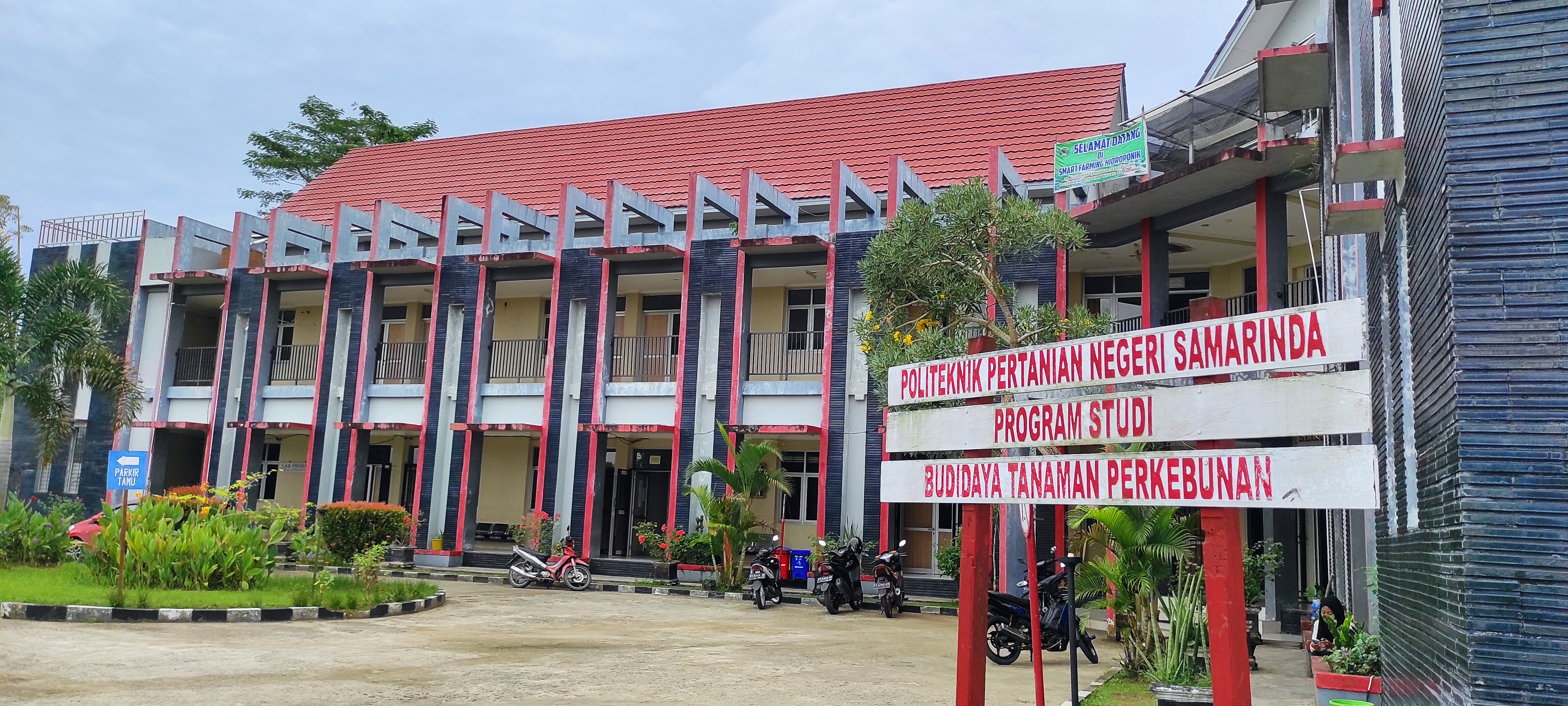
Budidaya Tanaman Perkebunan
Program Studi Budidaya Tanaman Perkebunan VISI “Menjadi salah satu program studi vokasi unggulan secara nasional dalam budidaya tanaman perkebunan pada tahun 2018.” MISI Melaksanakan program pendidikan yang beroreantasi aplikasi dan menghasilkan lulusan yang dapat menerapkan teori kedalam praktek. Mengembangkan intelektual mahasiswa secara komprehensif dalam suasana lingkungan yang kondusip. Mendidik mahasiswa dengan kualitas kepemimpinan dan professional, berpikir mandiri secara kritis dan analitis dan memiliki sifat kewirausahaan dan memahami kompleksitas global. Melaksanakan penelitian yang bersifat terapan sesuai dengan kebutuhan industri dan masyarakat. TUJUAN Menghasilkan lulusan sebagai ahli madya yang professional dalam bidang budidaya tanaman perkebunan. Menghasilkan lulusan yang mempunyai sifat kewiarausahaan dan mampu bersaing dalam era global. Menyelenggarakan penelitian aplikatif dan kerjasama dengan industri dalam bidang perkebunan. Menyelenggarakan pendidikan dengan sistem manajemen yang transparan guna mewujudkan suasana akademik yang kondusif. SASARAN DAN STRATEGI Menyelenggarakan pendidikan professional DIII dalam bidang budidaya tanaman perkebunan sebagai pemenuhan kebutuhan nasional akan tenaga ahli madya. Membentuk kemampuan hard skill mahasiswa dibidang budidaya tanaman perkebunan yang siap pakai dalam kurun waktu 3 tahun perkuliahan. Membentuk kemampuan soft skill dan interpersonal mahasiswa yang baik pada tahun pertama. Membentuk peserta didik berkompetisi dan mengembangkan sikap professional dalam bidang budidaya tanaman perkebunan. Memiliki wawasan bisnis (wirausaha) dalam bidang budidaya tanaman perkebunan. Melakukan magang diperkebunan untuk pengembangan pengetahuan tentang budidaya tanaman perkebunan. Alumni dapat bekerja diberbagai perusahaan/instansi dalam waktu kurang 6 bulan setelah kelulusan. Dapat mengimplementasikan hasil karya ilmiah dalam proses pendidikan dan pengajaran yang berkualitas. DOSEN - DOSEN PENGAJAR Nur Hidayat, SP. M.Si – NIP. 197210252001121001 Nurlaila, SP, MP – NIP. 197110302001122001 Faradilla, SP, M.Sc – NIP. 197401092000122001 Yuanita, SP, MP – NIP. 196611252001122001 F. Silvi Dwi Mentari, S.Hut, MP – NIP. 197707232003122002 Roby, SP, MP – NIP. 197305172005011009 Rusmini, SP, MP – NIP. 198111302008122002 Riama Rita Manulang, SP, MP – NIP. 196611252001122001 Daryono, SP, MP – NIP. 198002022008121002 TENAGA ADMINISTRASI Siti Jubaidah, S.Sos – NIP. 196809051991032001 Rosita, SE – NIP. 197203081993032001
→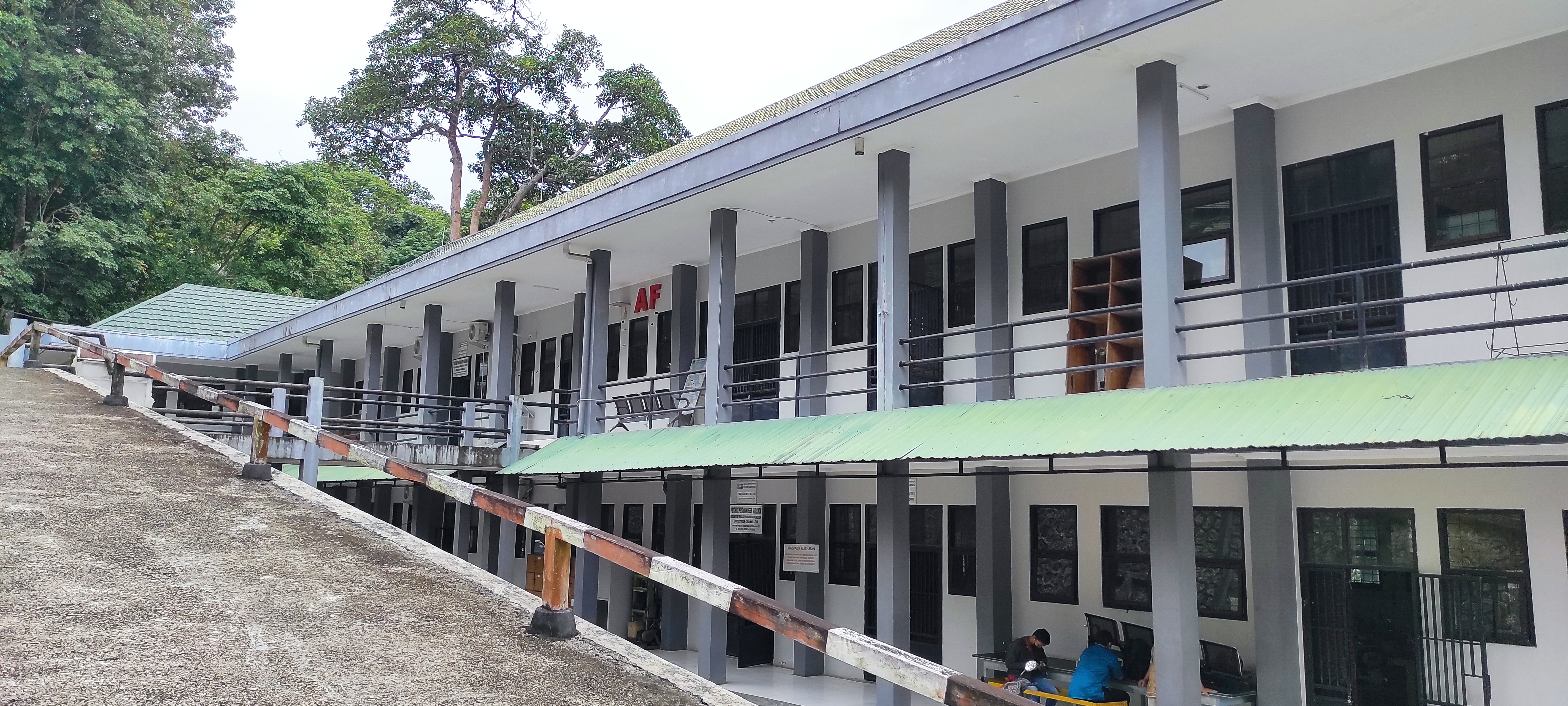
Teknologi Hasil Perkebunan
Program Studi Teknologi Hasil Perkebunan VISI : “Terwujudnya program studi yang profesional, berkualitas memiliki keunggulan komparatif dan kompetitif untuk menghasilkan lulusan yang berkualitas” MISI : Menyelenggarakan pendidkan vokasi bidang teknologi Hasil Perkebunan dengan mengembangkan dan mendayagunakan ilmu pengetahuan dan teknologi (IPTEK) untuk meningkatkan kualitas sumberdaya manusia (SDM). TUJUAN : Mempersiapkan peserta didik menjadi tenaga siap pakai dibidang teknologi hasil perkebunan. Mempersiapkan peserta didik menjadi anggota masyarakat yang memiliki kemampuan profesional dan berjiwa wirausaha di bidang teknologi pengpahan hasil perkebunan. Melaksanakan penelitian terapan untuk pengembangan ilmu pengetahuan dan teknologi terapan di bidang pengolahan hasil perkebunan. Menyebarluaskan bidang pengetahuan teknologi pengolahan hasil perkebunan untuk meningkatkan taraf kehidupan masyarakat dan memperkaya kebuadayaan nasional. Membina dan mengembangkan kerjasama kelembagaan yang saling menguntungkan dengan instansi pemerintah ataupun swasta demi terciptanya iklim kehidupan akademik yang sehat dan dinamis untuk membentuk msyarakat ilmiah yang menjunjung tinggi kebenaran, kejujuran serta terbuka, kritis, bertanggung jawab,kreatif, inovatif produktif, dan tanggap terhadap perkambangan zaman. Menjadi pusat informasi pengolahan hasil perkebunan di Kalimantan Timur. SASARAN & STRATEGI : Terciptanya lulusan Teknologi Hasil Perkebunan yang handal dan profesionnal melalui pengembangan sistem pembelajaran dan peningkatan sarana dan prasarana pembelajaran serta menciptakan suansana akademik yang baik. Meningkatkan mutu penelitian di bidang teknologi Hasil Perkebunan yang akan memperkaya ilmu pengetahuan dan mengembangkan potensi industri kehutanan dan kearifan lokal dengan meningkatkan kualitas laboratorium, sumberdaya manusia, kerjasama dan publikasi. DAFTAR PENGAJAR (DOSEN) : Rudito, S.TP, MP – NIP. 19690619 200312 1 001 Edy Wibowo K, S.TP,M.Sc – NIP. 19741118 200012 1 001 Andi Lisnawati, SP, M.Si – NIP. 19750210 200312 2 002 Mujibu Rahman,S.Tp, M.Si – NIP. 19711027 200212 1 002 Hamka, S.TP, M.Sc – NIP. 19760408 200812 1 002 Netty Maria N, S.TP, M.Sc – NIP. 19851002 200812 2 001 Elisa Ginsel Popang, S.TP, M.Sc – NIP. 19701229 200312 1 001 Khusnul Khotimah, S.TP, M.Sc – NIP. 19791025 200604 2 002 Ahmad Zamroni, S.Hut, MP – NIP. 19830824 200912 1 006 M. Atta Bary, SP, M.Si – NIP. 19760727 200312 1 002 Muh. Yamin, S.TP, M.Si – NIP. 19740813 200212 1 001 Dr. Andi Early F, S.TP – NIP. 19710226 200212 2 001 Ernita Obeth, SP, M. Agribuss – NIP. 19770524 200212 2 001 Anis Syauqi, S.TP, M.Sc – NIP. 19761209 200312 1 002 TENAGA ADMINISTRASI: Erdawati – NIP. 19650602 199002 2 001 Hairul Anwar – NIP. 19690603 199002 1 001
→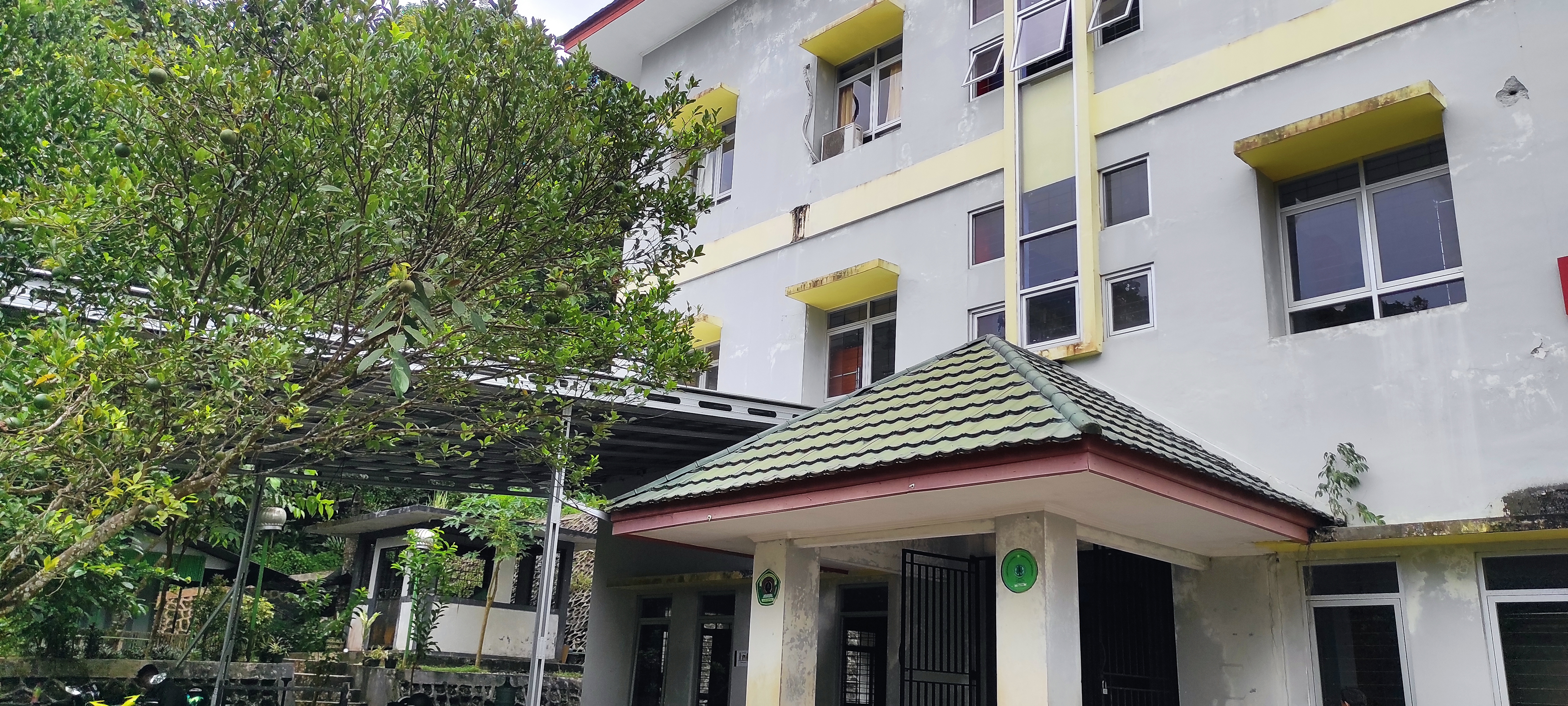
Pengelolaan Lingkungan
Program Studi Pengelolaan Lingkungan Program studi ini didirikan dalam rangka memenuhi tuntutan pembangunan yang terus berkembang dan perlu diiringi dengan upaya pengelolaan lingkungan oleh sumber daya manusia yang memadai dibidangnya agar pembangunan tersebut dapat dilaksanakan dan bermanfaat secara berkelanjutan. VISI : “Menjadi salah satu program studi vokasi unggulan secara nasional dalam manajemen lingkungan pada tahun 2018.” MISI : Melaksanakan program pendidikan yang beroreantasi aplikasi dan menghasilkan lulusan yang dapat menerapkan teori kedalam praktek. Mengembangkan intelektual mahasiswa secara komprehensif dalam suasana lingkungan yang kondusip. Mendidik mahasiswa dengan kualitas kepemimpinan dan professional, berpikir mandiri secara kritis dan analitis dan memiliki sifat kewirausahaan dan memahami kompleksitas global. Melaksanakan penelitian yang bersifat terapan sesuai dengan kebutuhan industri dan masyarakat. TUJUAN Menghasilkan lulusan sebagai ahli madya yang professional dalam bidang manajemen lingkungan. Menghasilkan lulusan yang mempunyai sifat kewiarausahaan dan mampu bersaing dalam era global. Menyelenggarakan penelitian aplikatif dan kerjasama dengan industri dalam bidang perkebunan. Menyelenggarakan pendidikan dengan sistem manajemen yang transparan guna mewujudkan suasana akademik yang kondusif. SASARAN DAN STRATEGI Menyelenggarakan pendidikan professional DIII dalam bidang Manajemen Lingkungan sebagai pemenuhan kebutuhan nasional akan tenaga ahli madya. Membentuk kemampuan hard skill mahasiswa dibidang Manajemen Lingkungan yang siap pakai dalam kurun waktu 3 tahun perkuliahan. Membentuk kemampuan soft skill dan interpersonal mahasiswa yang baik pada tahun pertama. Membentuk peserta didik berkompetisi dan mengembangkan sikap professional dalam bidang Manajemen Lingkungan. Memiliki wawasan bisnis (wirausaha) dalam bidang Manajemen Lingkungan. Melakukan magang diperkebunan untuk pengembangan pengetahuan tentang manajemen lingkungan. Alumni dapat bekerja diberbagai perusahaan/instansi dalam waktu kurang 6 bulan setelah kelulusan. Dapat mengimplementasikan hasil karya ilmiah dalam proses pendidikan dan pengajaran yang berkualitas. DAFTAR PENGAJAR (DOSEN) : Dr. Taufiq Rinda Alkas, S.Si, M.Pd – NIP. 19780517 200912 1 002 Nuzula Elfa Rahma, Sp, M.Si – NIP. 19820713 201404 2 001 Wardatul Hidayah, S.Si., M.Si. - NIP. 19941031 202203 2 015 Diepa Febriana Wulandari, S.Pd., M.Sc. – NIP. 19940219 202203 2 024 Niswatun Hasanah, S.Si., M.Si. – NIP. 19860710 202421 2 023 Nur Isra, SP., M.Ling.– NIP. 19941231 202406 1 002 Shalehuddin Denny Ma'ruf, S.Hut., M.Ling. – NIP. 19941222 202406 1 001 Afriandi Setiawan, SP., M.Ling. – NIP. 19940417 202506 1 005 TENAGA ADMINISTRASI Annisa Aulia Rahman, S.Kom. – NIP. 19950831 202521 2 057
→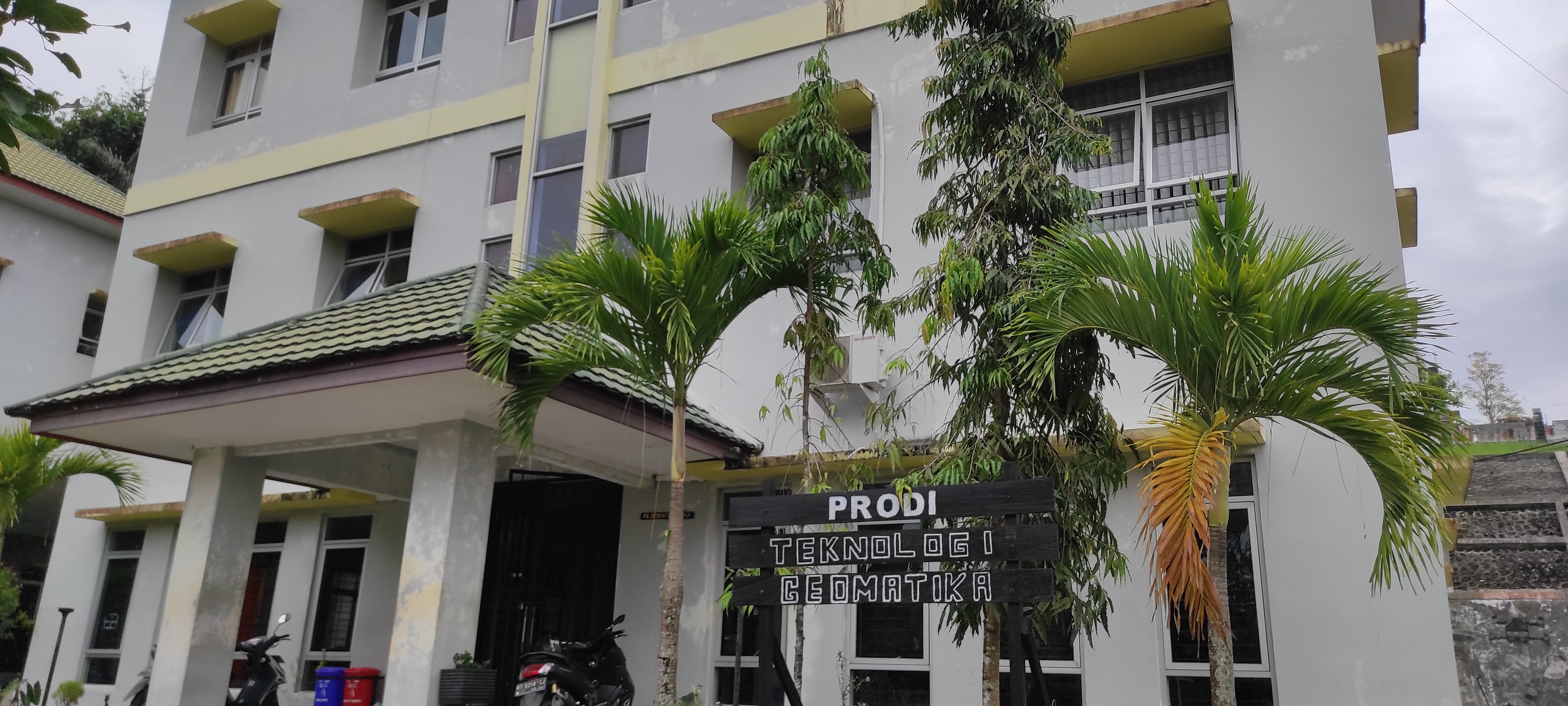
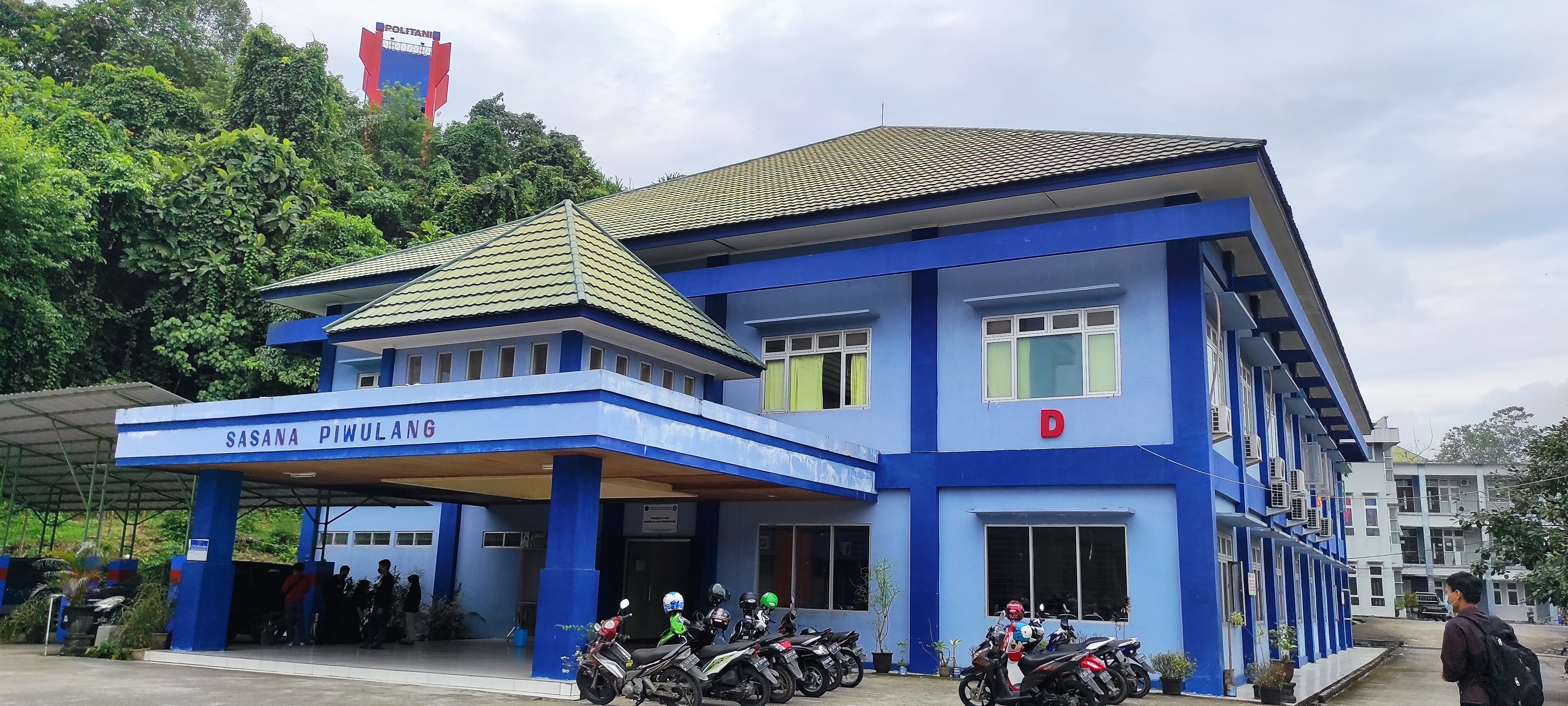
Teknologi Geomatika
Program Studi Teknologi Geomatika VISI : “Menjadikan program studi vokasi unggul di bidang survei, pemetaan dan sistem informasi spasial” MISI : Menyelenggarakan pendidikan vokasi untuk menghasilkan lulusan yang menguasai ketrampilan di bidang Geoinformatika; Mendidik mahasiswa dengan kualitas kepemimpinan dan profesional, berpikir mandiri secara kritis, inovatif dan aplikatif serta memiliki sifat kewirausahaan; Melaksanakan penelitian terapan di bidang informatika; Melaksanakan pengabdian kepada masyarakat, terutama di bidang Geoinformatika terapan yang berorientasi pada kesejahteraan rakyat; Melaksanakan program kemitraan dengan pendidikan sejenis dan para pihak (stakeholder) baik dalam maupun luar negeri. TUJUAN : Menghasilkan lulusan sebagai Ahli Madya Geom (A.Md Geo) yang terampil dan profesional dalam bidang Geoinformatika; Menghasilkan lulusan yang mempunyai jiwa kewirausahaan dan mampu bersaing dalam era global; Melaksanakan penelitian terapan dan kerjasama dengan industri dalam bidang Geoinformatika; Menyelenggarakan pendidikan dengan sistem manajemen yang transparan guna mewujudkan atmosfir akademik yang kondusif. SASARAN & STRATEGI : Untuk memastikan ketersediaan input, program studi Geoinformatika secara rutin mengadakan kunjungan ke SMA/SMK untuk mempromosikan dirinya; Mengadakan kerjasama dengan pihak swasta dalam penempatan PKL mahasiswa; Menambah alat praktik lapang dan alat laboratorium untuk menunjang proses belajar mengajar; Meningkatkan kualitas dosen dan PLP melalui pelatihan-pelatihan/magang; Mengadakan kerjasama dengan para pihak (stakeholder) dalam penelitian dan peningkatan sumber daya manusia. DAFTAR PENGAJAR (DOSEN) : Andrew Stefano, MT – NIP. 19760315 200912 1 002 Ir. Suparjo, MP – NIP. 19620817 198903 1 003 Husmul Beze, S.Hut., M.Si – NIP. 19790613 200812 1 003 Dawamul Arifin, S.T., M.T – NIP. 19901118 201404 1 001 Radik Khairil Insanu, S.T., M.T – NIP. 19901012 201404 1 002 Dwi Agung Pramono, S.Hut, MP – NIP. 19871004 201504 1 002 F.V Astrolabe Sian Prasetya, ST, MT – NIP. 19900122 201504 1 001 TENAGA ADMINISTRASI: Jainah – NIP. 19640408 199303 2 002 Eddy, SE – NIP. 19670612 199403 1 003
→
Pengelolaan Perkebunan
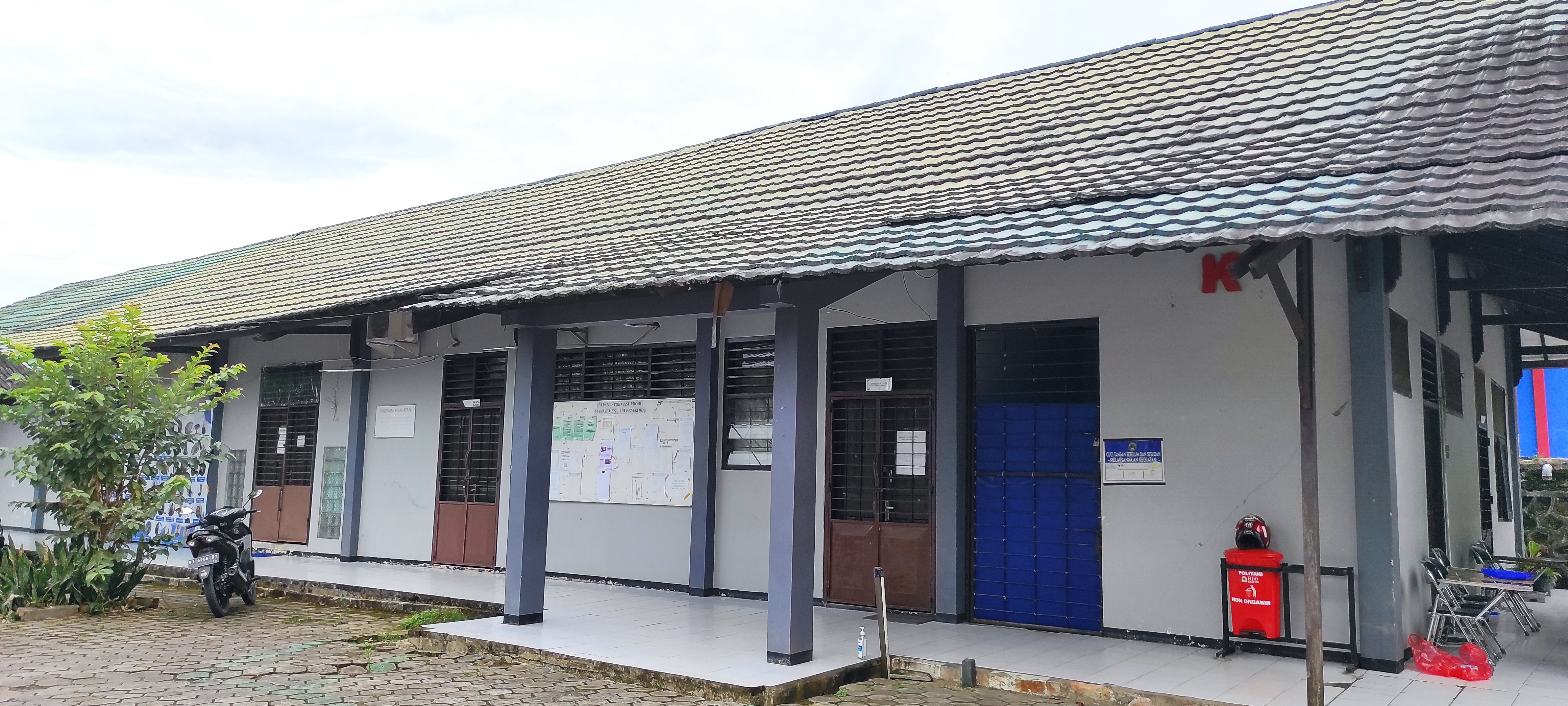
Program Studi Pengelolaan Perkebunan VISI “Menjadi program studi unggulan penyelenggara pendidikan sarjana sains terapan dalam bidang manajemen perkebunan yang menunjang pembangunan perkebunan berstandar internasional.” MISI Menyelenggarakan pendidikan tinggi vokasional pada diploma IV pada bidang manajemen perkebunan. Menyelenggarakan proses pendidikan yang beroreantasi kepada sistem manajemen mutu kearah GAP (Good Agriculture Practices), GHP (Good Handling Practices) dan GMP (Good Manufacturing Practices). TUJUAN “Menghasilkan lulusan yang menguasai kemampuan professional dalam mengelola pekerjaan yang kompleks dalam usaha perkebunan.” SASARAN DAN STRATEGI Terselenggaranya pendidikan manajemen perkebunan yang berbasis GAP (Good Agricultur Practices) dan beroreantasi interpreneurship. Terselenggaranya pengembangan iptek terapan melalui penelitian dan pengabdian kepadan masyarakat. Terselenggaranya kerjasama dengan stakehoulders. Terselenggaranya uji kompetensi yang bersertifikasi. DAFTAR PENGAJAR (DOSEN) : Arief Rahman, S.P., M.Sc – NIP. 19921221 201903 1 014 Dr. Ir. Hj. Budi Winarni, M.Si – NIP. 19610914 199001 2 001 Jamaluddin, SP, M.Si – NIP. 19720612 200112 1 003 Sri Ngapiatun, SP, MP – NIP. 19770827 200112 2 002 Dr. Rusli Anwar, SP, M.Si – NIP. 19701101 200501 1 003 Rossy Mirasari, SP, MP – NIP. 19780624 200501 2 002 Ernita Obeth, M.Agribus,Ph.D – NIP. 19770524 200212 2 001 Humairo Aziza, S.Hut., M.P – NIP. 19840108 201903 2 009 Sukariyan,S.Hut., M.P – NIP. 19710514 199803 1 003 Puspita, S.E., M.Pd. – NIP. 19750708 200112 2 003 PRANATA LABORATORIUM PENDIDIKAN Sri Marlendi, A.Md – NIP. 19820918 201404 2 001 TENAGA ADMINISTRASI Rudi Purnomo – NIP. 19790508 200312 1 001 Siti Mariam – NIP. 19660707 199002 2 001 Winda Kurnia Setiawati
→
Teknologi Rekayasa Perangkat Lunak
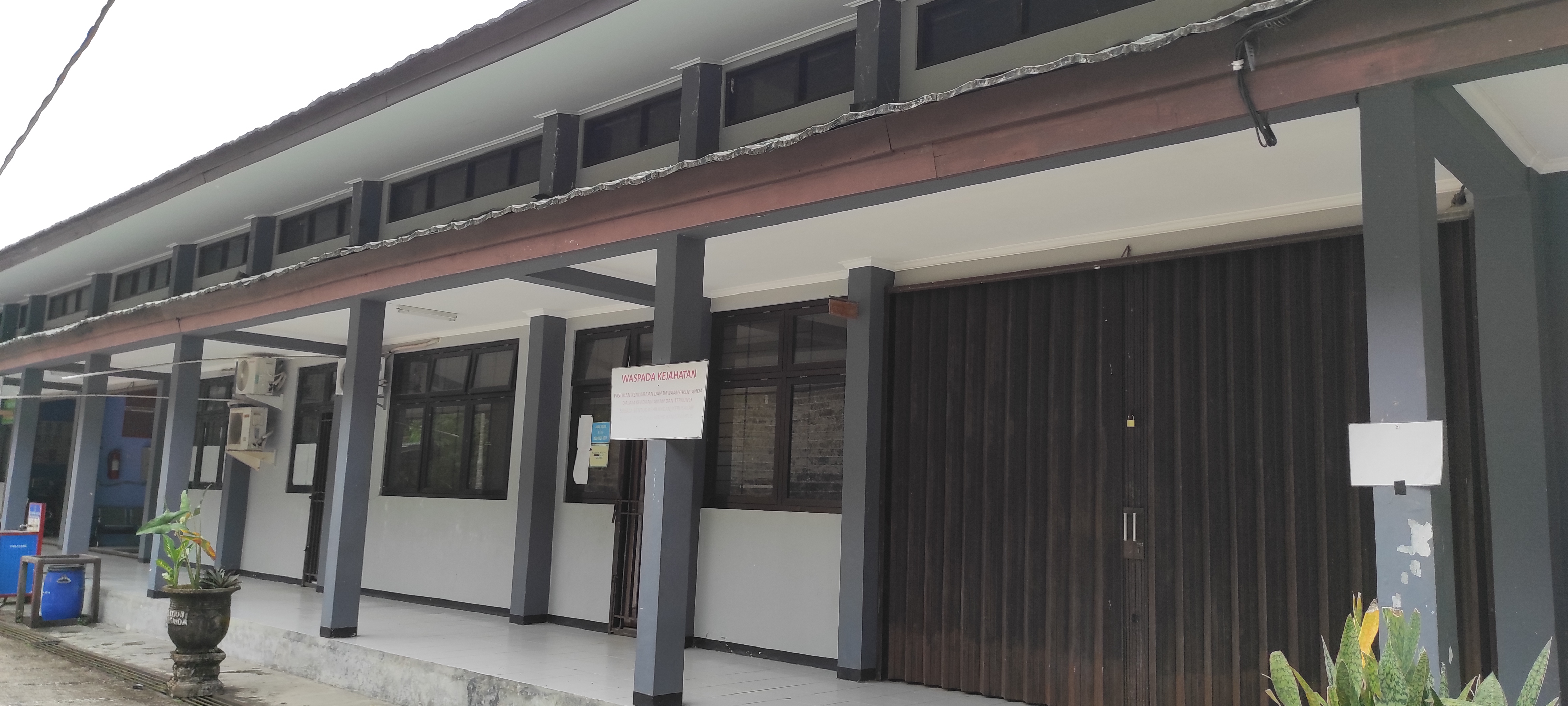
Teknologi Rekayasa Perangkat Lunak VISI : Menjadi program studi yang unggul di Kalimantan dalam pendidikan vokasi bidang teknologi informasi cerdas pada tahun 2027 MISI : Menyelenggarakan proses pembelajaran yang berkualitas untuk menghasilkan lulusan yang professional, siap kerja dan mampu bersaing di bidang teknologi informasi Menggalang kegiatan penelitian yang bermutu dan memiliki manfaat untuk meningkatkan kemajuan ilmu pengetahuan di bidang teknologi dan informasi Meningkatkan pemanfaatan keilmuan di bidang teknologi informasi Menjalin kerjasama dan kemitraan dengan lembaga baik pemerintah maupun dunia usaha di bidang teknologi informasi TUJUAN PROGRAM STUDI : Menyiapkan lulusan yang bertakwa kepada Tuhan Yang Maha Esa serta berbudi pekerti luhur Menghasilkan lulusan Teknologi Rekayasa Perangkat Lunak yang kompeten dan kreatif di bidang teknologi informasi Menerapkan hasil pengetahuan dan penelitian di bidang teknologi informasi untuk meninngkatkan kesejahteraan masyarakat khususnya di Kalimantan Timur. STRATEGI PROGRAM STUDI : Untuk mencapai visi dan misi Program Studi Teknologi Rekayasa Perangkat Lunak Politeknik Pertanian Negeri Samarinda maka di buatlah Sasaran Program Program Studi Teknologi Rekayasa Perangkat Lunak. Seperti yang tercantum dalam Buku Kurikulum Politeknik Pertanian Negeri Samarinda Program Studi Teknologi Rekayasa Perangkat Lunak, sasarannya dibagi ke dalam tiga jangka waktu yaitu, jangka pendek, jangka mengengah dan jangka panjang. Sasaran Jangka Pendek (2024) Program Studi Teknologi Rekayasa Perangkat Lunak antara lain : 1. Meningkatkan jumlah dosen tersertifikasi pengajar minimal 25%. 2. Menghasilkan penelitian bertaraf nasional sebanyak 50% dari jumlah dosen. 3. Meningkatkan kualitas pengajaran dan pendidikan dosen hingga minimal 25% dosen memiliki sertifikasi kompetensi. 4. Pencapaian prestasi akademik yang tinggi dengan cara meningkatkan rata-rata IPK 2.75. 5. Mencapai target masa studi 4 tahun sebanyak 75%. 6. Masa tunggu lulusan mendapatkan pekerjaan dibawah enam bulan minimal 50%. 7. Tingkat kesesuaian pekerjaan lulusan dengan bidangnya minimal 50%. 8. Menyelenggarakan proses pembelajaran yang berkualitas dan memenuhi standar nasional. Sasaran ketercapaian visi, misi dan tujuan pada tahun 2032 (Jangka Menengah) adalah: 1. Meningkatkan jumlah dosen tersertifikasi pengajar minimal 50%. 2. Menghasilkan penelitian bertaraf nasional dan internasional sebanyak 75% dari jumlah dosen keseluruhan. 3. Meningkatkan kualitas pengajaran dan pendidikan dosen hingga minimal 50% dosen memiliki sertifikasi kompetensi. 4. Pencapaian prestasi akademik yang tinggi dengan cara meningkatkan rata-rata IPK 3.00. 5. Mencapai target masa studi 4 tahun sebanyak 90%. 6. Masa tunggu lulusan mendapatkan pekerjaan dibawah enam bulan minimal 75%. 7. Tingkat kesesuaian pekerjaan lulusan dengan bidangnya minimal 75%. 8. Menyelenggarakan proses pembelajaran yang berkualitas dan memenuhi standar nasional. Sasaran ketercapaian visi, misi dan tujuan pada tahun 2042 (Jangka Panjang) adalah: 1. Meningkatkan jumlah dosen tersertifikasi pengajar minimal 90%. 2. Menghasilkan penelitian bertaraf nasional dan internasional minimal 100% dari seluruh dosen. 3. Meningkatkan kualitas pengajaran dan pendidikan dosen hingga minimal 80% dosen memiliki sertifikasi kompetensi. 4. Pencapaian prestasi akademik yang tinggi dengan cara meningkatkan rata-rata IPK 3.25. 5. Mencapai target masa studi 4 tahun mencapai 100%. 6. Masa tunggu lulusan mendapatkan pekerjaan dibawah enam bulan minimal 80%. 7. Tingkat kesesuaian pekerjaan lulusan dengan bidangnya minimal 80%. 8. Menyelenggarakan proses pembelajaran yang berkualitas dan memenuhi standar internasional. DAFTAR PENGAJAR (DOSEN) : Yulianto, S.Kom, M.MT – NIP. 19830719 200912 1 007 Husmul Beze, S.Hut., M.Si – NIP. 19790613 200812 1 003 Dr. Suswanto, S.Pd, M.Pd – NIP. 19680525 199512 1 001 Eny Maria, S.Kom., M.Cs – NIP. 19881105 201803 2 001 Budi Rachmadani, S.PD., M.PD – NIP. 19741013 200112 1 003 Syafei Karim, S.Kom., M.Kom – NIP. 19921207 201903 1 010 Eko Junirianto, S.Kom., M.Kom – NIP. 19890602 201803 1 001 Annafi' Franz, S.Kom., M.Kom – NIP. 19910602 201903 1 016 Emil Riza Putra, S.Kom., SE., M.Kom – NIP. 19920819 201903 1 014 Muslimin B., S.Kom., M.Cs – NIP. 19850412 201903 1 010 Reza Andrea, S.Kom., M.Kom – NIP. 19890605 201903 1 017 Suci Ramadhani, S.Kom., M.Kom – NIP. 19880428 201903 2 013 Ida Maratul Khamidah, S.Kom., M.Cs – NIP. 19910113 201903 2 023 Asep Nurhuda, S.Kom., M.Kom – NIP. 19890208 202012 1 003 Fajar Ramadhani, S.Kom., M.Kom – NIP. 19930303 202203 1 009 PRANATA LABORATORIUM PENDIDIKAN (PLP) : Lisnawati, A.Md – NIP. 19741013 200112 1 003 Nur Aini, S.Kom – NIP. 19911129 201903 2 020 Sabrani, S.Tr.Kom TENAGA ADMINISTRASI: Marlin Natalia. H, S.KM
→
Rekayasa Kayu
Program Studi Rekayasa Kayu VISI : Menjadi Program Studi Jenjang Diploma 4 yang Unggul di Bidang Rekayasa Kayu MISI : Mengembangkan pengetahuan dibidang rekayasa kayu dan menekankan pada penelitian yang berlandaskan kompetensi, keterampilan, teknologi, etika dan kearifan lokal Menyelenggarakan pendidikan jenjang diploma 4 berkelanjutan dan profesi di bidang desain produk kayu, perbaikan kualitas kayu dan konstruksi bangunan kayu Membentuk lulusan yang bermoral, tangguh, terampil, kreatif dan berjiwa wirausaha Meningkatkan pengabdian kepada masyarakat atas dasar tanggung jawab sosial. Menjamin kerjasama secara berkelanjutan dengan lembaga pendidikan, lembaga penelitian, pemerintah dan dunia usaha serta masyarakat. TUJUAN : Menghasilkan lulusan sarjana terapan yang memiliki kompentensi, keterampilan, penguasaan ilmu pengetahuan dan teknologi yang beretika Menghasilkan teknologi terapan di bidang rekayasa kayu yang dapat dimanfaatkan untuk meningkatkan taraf hidup masyarakat Menghasilkan lulusan yang bermoral, tangguh, terampil, kreatif dan berjiwa wirausaha Menghasilkan karya ilmiah dan penelitian di bidang perkayuan yang dipublikasikan Menghasilkan kerjasama yang berkelanjutan dengan lembaga pendidikan, lembaga penelitian, pemerintah dan dunia usaha serta masyarakat DAFTAR PENGAJAR (DOSEN) : Dr. Ir. Iskandar, MP – NIP. 19591119 198710 1 001 Dr. Ir. F. Dwi Joko Priyono, MP – NIP. 19581017 198803 1 001 Ir. Yusdiansyah, MP – NIP. 19591216 198903 1 002 Dr. Ir. Taman Alex, MP – NIP. 19600121 198903 1 008 Dr. Ir. Syafi’i, MP – NIP. 19680610 199512 1 001 Dr. Abdul Rasyid Zarta, S.Hut., MP – NIP. 19750827 199903 1 001 Eva Nurmarini, S.Hut., MP – NIP. 19750808 199903 2 002 Dr. Ita Merni Patulak, SE, MM – NIP. 19720525 200212 2 010 TENAGA ADMINISTRASI : Erdawati – NIP. 19650602 19902 2 001) Rusydi, A.Md
→Sistem Informasi Akutansi
Teknologi Produksi Tanaman Pangan
Teknologi Rekayasa Geomatika dan Survey
Teknologi Rekayasa Pengendalian Pencemaran Lingkungan
PROGRAM STUDI TRPPL (Teknologi Rekayasa Pengendalian Pencemaran Lingkungan) Visi : "Menjadi program studi yang professional dan unggul dalam bidang rekayasa Pengendalian Pencemaran Lingkungan" Misi : Menghasilkan lulusan sarjana Sains terapan yang professional, berintegritas, terampil Dan ahli dibidang rekayasa pengendalian pencemaran lingkungan Melaksanakan penelitian aplikatif dan rekayasa pengendalian pencemaran lingkungan Menyediakan jasa pelayanan Pendidikan, pelatihan dan konsultasi dibidang rekayasa pengendalian pencemaran lingkungan Daftar Pengajar (Dosen) : Kemala Hadidjah, ST., M.Si Dr. Martha Ekawati Siahaya, S.Hut., MP Fachruddin Azwari., ST, M.Si Adi Supriadi, S.Hut., M.Si Christine Elia Benedicta, S.Hut., M.Ling Christopaul Pala'langan Toding Layuk, S.P., M.Ling Andi Gita Tenri Sumpala, S.Si., M.Ling. Dr. Arini Rajab, S.Si., M.Si. Daftar Pranata Laboratorium Pendidikan (PLP) Rusli Wahyuni, A.Md Estu Pangaribowo, A.Md Joko Triyono, S.Kel Daftar staff Administrasi Sise Karmita, S.S.T
→Teknologi Rekayasa Pangan
PROGRAM STUDI TRP (Teknologi Rekayasa Pangan) VISI : “MENJADI program studi sarjana terapan yang unggul dalam menghasilkan lulusan yang mampu menciptakan inovasi pangan bernilai tambah, berkontribusi pada ketahanan pangan nasional, dan berdaya saing di pasar global.” MISI : Menyiapkan lulusan yang memiliki kompetensi yang dibutuhkan oleh industry pangan masa depan, termasuk kemampuan dalam riset, pengembangan produk, dan Manajemen kualitas. Mendorong pemanfaatan sumber daya lokal dan mengurangi ketergantungan pada bahan impor dalam industry pangan. Membangun kemitraan yang kuat dengan industri, pemerintah, dan Lembaga penelitian untuk mendorong pengembangan teknologi pangan di Indonesia Menyelenggarakan program Pendidikan yang berorientasi pada praktik dan relevan dengan kebutuhan industri. Membudayakan semangat kewirausahaan di kalangan mahasiswa melalui berbagai program inkubasi bisnis dan kompetisi bisnis. Daftar pengajar (DOSEN) Dr. Edy Wibowo Kurniawan, S. TP., M.Sc. Mujibu Rahman, S.TP., M.Si. Dr. Rudito, S.TP., MP. Hamka, S. TP., MP., M.Sc. Netty Maria Naibaho, S.TP., MP, M.Sc. Dr. Ahmad Zamroni, S.Hut.,MP Rahma Yanti T, S.Tr.P.,M.T.P Daftar Pranata Laboratorium Pendidikan (PLP) Daftar Administrasi 1. Sabrani, S.Tr.Kom
→Temukan Kampus
Lokasi Politani Samarinda
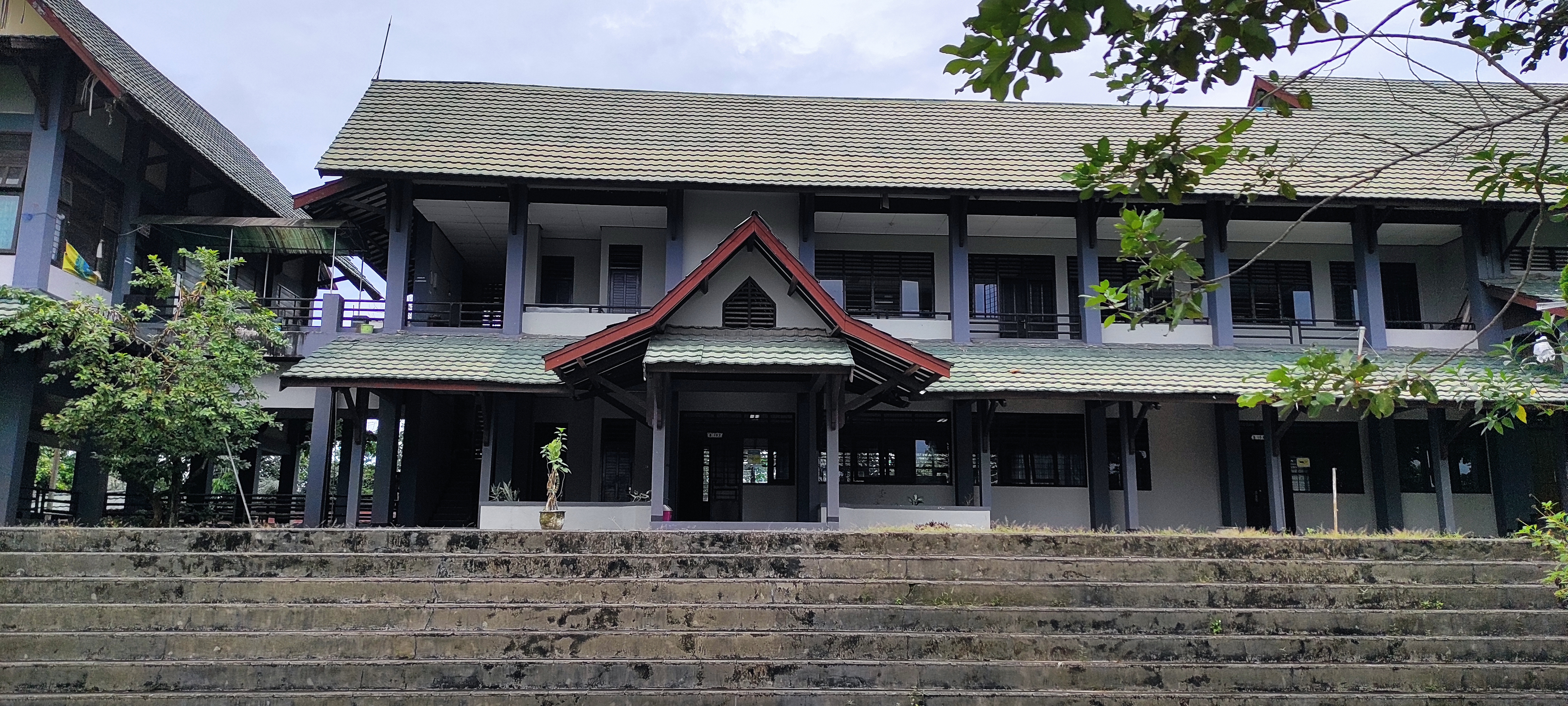
Politeknik Pertanian Negeri Samarinda berlokasi di Kelurahan Sungai Keledang, Kecamatan Samarinda Seberang, Kota Samarinda. Letaknya strategis di tepi Sungai Mahakam dengan lingkungan hijau dan asri yang mendukung kegiatan akademik serta penelitian.